AI in podcasts: when should you disclose it?
-
When should you say you use AI in your podcast? RSS
.com’s Alberto Betella has produced a new website called ’should I disclose’ to help creators know whether they should label their podcast episodes as AI-generated. The guidelines suggest disclosure is based on substance, rather than merely tools. It has an interactive questionnaire asking you six questions to help; and also links to platform guidelines. - When contacted by Podnews, Eric Nuzum from Magnificent Noise said that the website is “asking all the right questions”. However, he told us: “All podcasts require two things from their creators: passion and curiosity. AI can imitate the effects of those things, but it cannot be passionate or creative. So if anyone chooses to do the activities that the site suggests requires disclosure, I’m having trouble imagining it will ever achieve any audience impact worth considering.”
- John McDermott from Caloroga Shark Media, which produces content using AI as part of the process, tells us that “If an AI voice reads a story well, and allows something to get produced, I think it is a plus. I’m happy to disclose anything - I just don’t want to be unnecessarily penalized for it.”
- “Podcasting has been a medium built on authenticity and connection,” Amplifi Media’s Steven Goldstein told us. Adding that the website is helpful, he said: ”In my view, the issue isn’t whether AI is used. The issue is whether the audience is intentionally misled. Listener trust is foundational to the medium. Transparency matters."
- Inception Point AI was also contacted for comment, but the company had not responded by press time.
-
Apple Podcasts was launched as an app on iPhone in June 2012. It wasn’t the first podcast app - and there was one that was launched three years earlier: with some features that we take for granted today. That app was Google Listen, the first podcast app experiment by Google. In a new article today as part of our history collection, we unveil the v2 design that was never launched, its inevitable pivot to video, and the astonishing engagement figures that the app got - even if that didn’t save it from the Google graveyard.
-
On Purpose with Jay Shetty is to leave iHeartMedia in July. The show was conspicuously absent from the recent iHeart/Netflix deal. “We love Jay — we have enormous respect for him and what we’ve accomplished together, including both doubling his audience and his revenue, but as sometimes happens with professional relationships, we’re going in different directions,” the company said in an email to advertisers.
-
Token Count is a weekly podcast using AI, published using a single command. Trevor Prater, the creator of the show, says: "What makes it different from other AI audio experiments: it’s sustained (3 months of weekly episodes, not a one-off demo), the comedy actually works (distinct character dynamics, callbacks, natural escalation), and the production quality includes music beds, comedy stings, and performance-directed dialogue with interruptions, reactions, and varied delivery. The tech stack uses Gemini for script generation, ElevenLabs’ text-to-dialogue API for multi-speaker synthesis, Temporal for durable workflow orchestration, and publishes directly to Spotify.
-
“We couldn’t find a home for this on television”, said Jodie Tovay the cohost of Wisecrack, in her acceptance speech for Podcast Of The Year at The Ambies a few weeks ago. Well, that didn’t take long. UCP, a division of Universal Studio Group, has acquired the television rights in a competitive process. The writer will be Eli Journé, who is currently working on Severance for Apple TV; Eat The Cat will executive produce, alongside Tenderfoot TV, iHeartMedia and Starwipe Productions.
-
Want to make your own narrative story podcast? Caloroga Shark Media has launched Podbotz, a professional-quality audio narration story studio driven by AI. The tool is quite human-sounding, if the evidence of this love story between two dogs is anything to go by.
-
Airwave has signed popular history podcast The History Chicks, a show that brings the hidden stories of women in history to light.
-
The Media Leader posts The Rest is Video: Why user-generated content is an endangered species, suggesting that quality of production has significantly changed.
The Tech Stuff - with RSS.com
- A PDF isn’t a podcast - and that’s now official. After we reported in mid-January about Apple Podcasts documentation saying that podcast "episodes can be an audio recording, video recording, or text documents in M4A, MP3, MOV, MP4, M4V, or PDF file format”, Apple has quietly removed mention of PDF - which Apple hasn’t actually supported for a while - from the page. The company, which is set to launch an enhanced video service soon, has also removed wording claiming that audio is more popular than video.
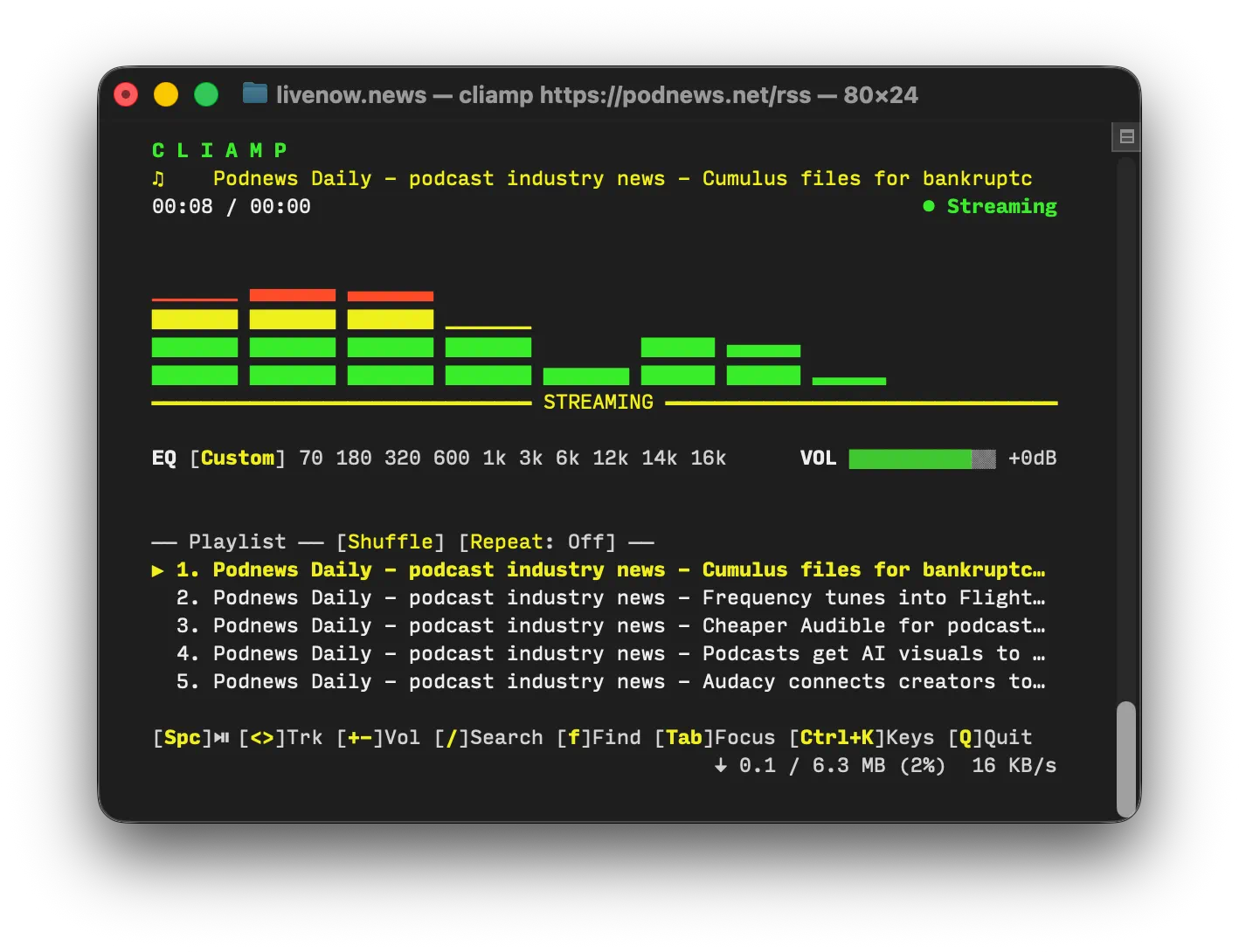
- Want a podcast and music player in a terminal window for Mac or Linux? It grabs audio from YouTube. It even deals with Spotify (if you’re premium). And of course, you can pass it an RSS URL. You’ll be wanting Cliamp. Here’s what it looks like playing our podcast.
Tips and tricks - with Riverside
- With video, lighting is important too - and, as Stephen Robles explains, a three-point lighting system is the best place to start.
- Podfading is a thing - but here are four simple rules to outlast 99% of podcasts from Samuel Sleger.
Podcast News - with Airwave


Podcast data
#1 in Apple Podcasts The Daily (The New York Times)
 The Rest Is History (Goalhanger)
#1 in Spotify The Joe Rogan Experience (Joe Rogan) The Rest Is Politics (Goalhanger)
Over the last week, 189,684 podcasts published at least one new episode (down 2.3%). source