Google Listen - Google's pioneering Android podcast app

In Jan 2007, the launch of the iPhone changed everything about mobile phones - with the App Store being launched in July 2008. The Apple Podcasts app was launched in June 2012.
But there was a podcast app that was launched three years before Apple Podcasts. It was a fully-featured podcast app - with a lot of features that we take for granted today.
And, it wasn’t on an iPhone at all.
That app was on Android phones; and called Google Listen.
Google Listen was launched in August 2009; posted by Research Scientists Bill Schilit and Sam Roweis. A product of Google Labs, the company’s home for prototypes and the famed Google “20% time” for side projects, the app was a free download for anyone with an Android phone. It described itself like this:
Listen from Google Labs brings podcasts and web audio to your Android-powered device. It lets you search, subscribe, download and stream. By subscribing to programs and search terms it will create a personalized audio-magazine loaded with fresh shows and news stories whenever you listen. In this release Listen is indexing thousands of popular English-only audio sources.
It looked like this at launch.
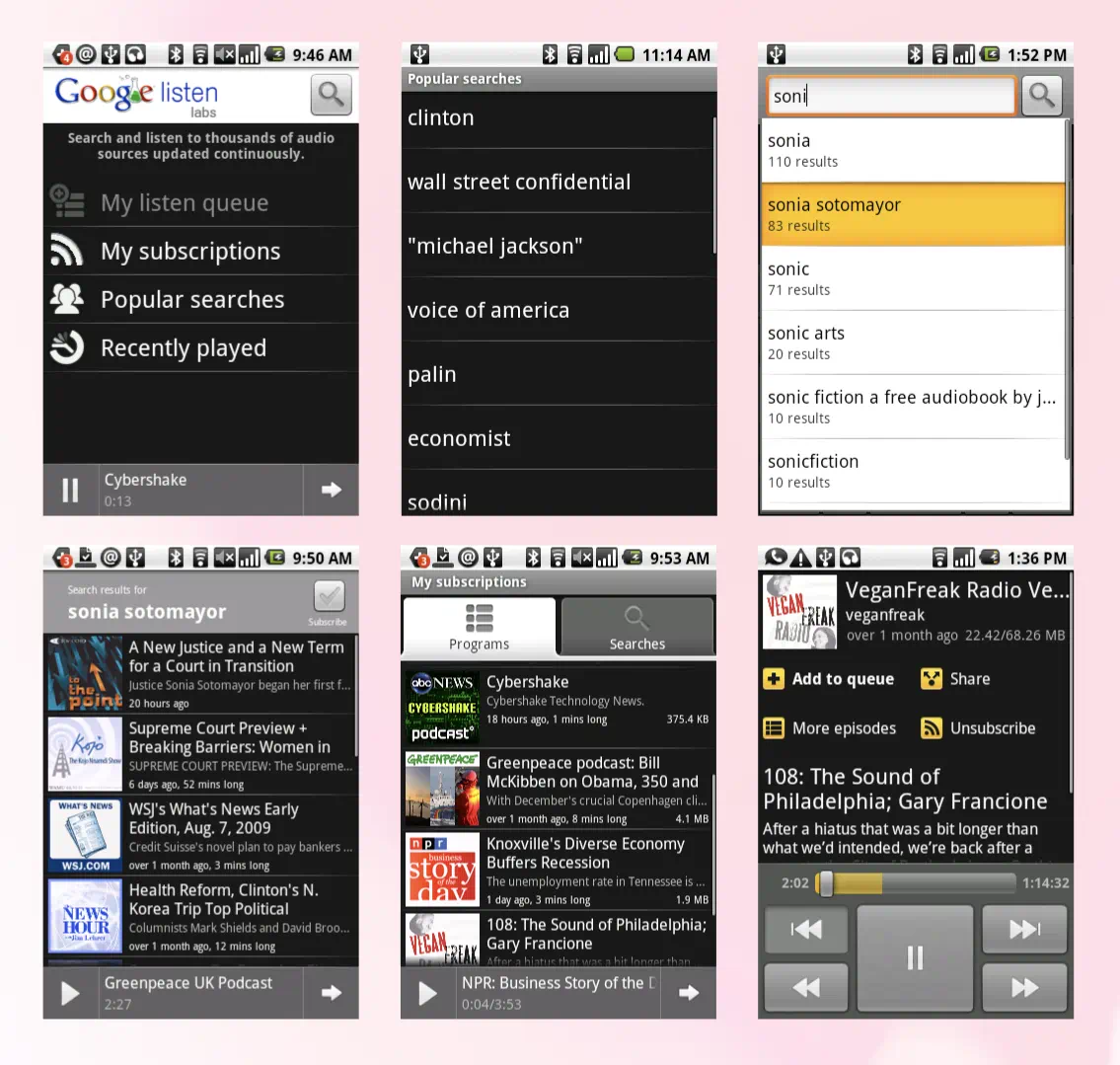
Within a month, v1.0.1 was launched, with some UX improvements and bug fixes. By the end of Dec 2009, the player had a “skip forward 30 seconds, back 7 seconds” feature (ad skipping had arrived!); and was correctly using a user-agent.
In February 2010 - after the launch of the brilliant Nexus One - a big change. Instead of Google Listen using RSS itself, the app moved to using Google Reader, a popular RSS reader at the time. Your podcast subscriptions were now in a Google Reader folder, where you could also see them (and, by that time, also comment on them with your friends). Here’s a review from AppJudgement at the time.
Still more than two years before the launch of Apple Podcasts as its own standalone app, Google Listen had iterated through a number of changes.
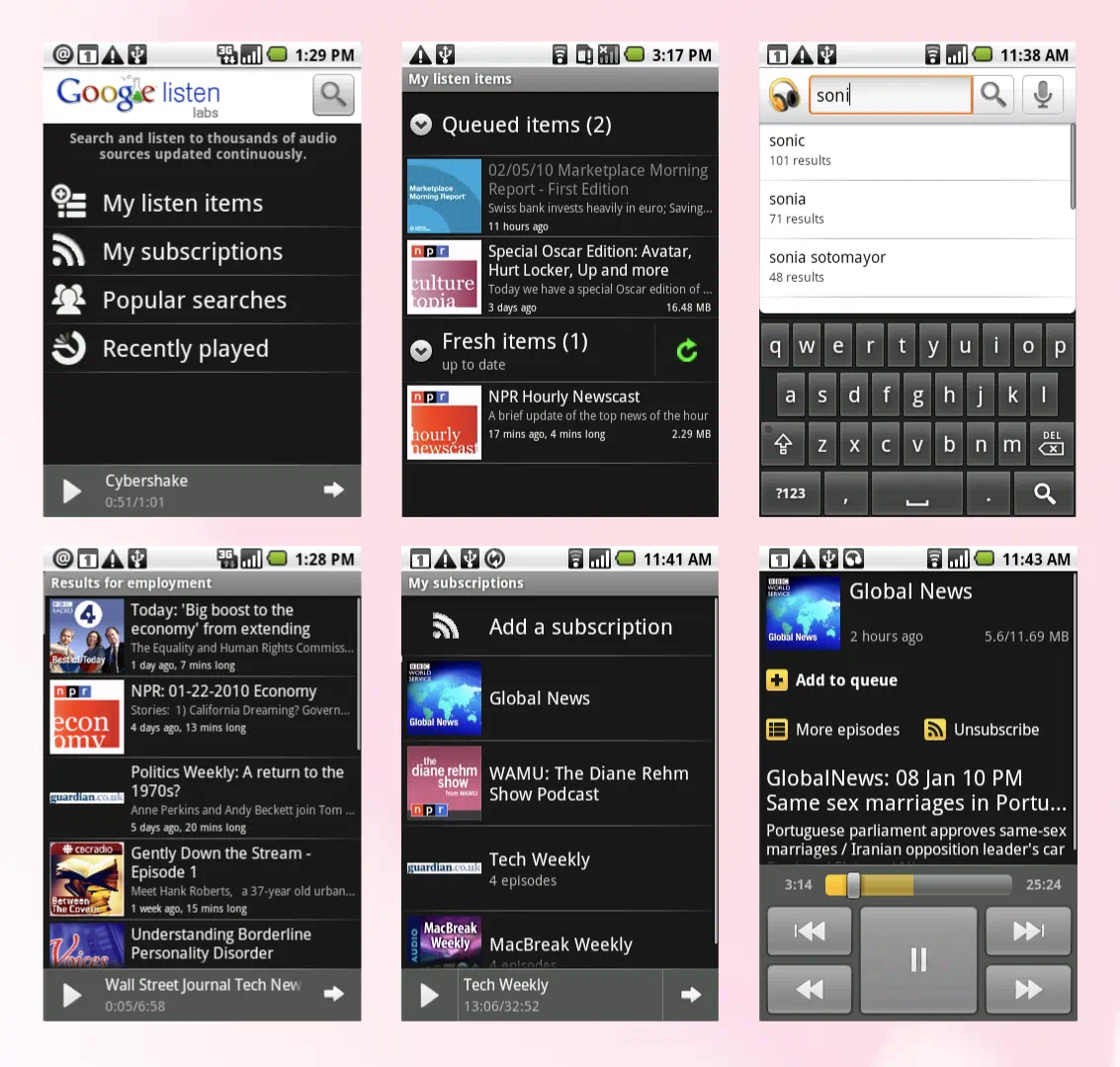
How Google Listen differed from other apps
“My subscriptions” let you subscribe to individual podcasts, as most other apps did - but also let you subscribe to search terms. Fascinated about Toyota cars, or the French Revolution, or the Laravel framework? Subscribing to that search would always show you "a recent episode whose content matches that search term”.
Your “listen queue” let you choose specific episodes to hear in a specific order. Listen would play your queue first, then automatically start playing your subscriptions. Play queues are surprisingly late to the party from other podcast apps!
Google Listen by the numbers
According to an internal document seen by Podnews, by January 2012 the app was achieving 580,000 monthly users (190,000 weekly users). Google Listen was shipped pre-installed on some HTC phones.
Users loved it. Internal Google numbers indicate that the average session duration was over an hour long: and the average user used it five times a week.
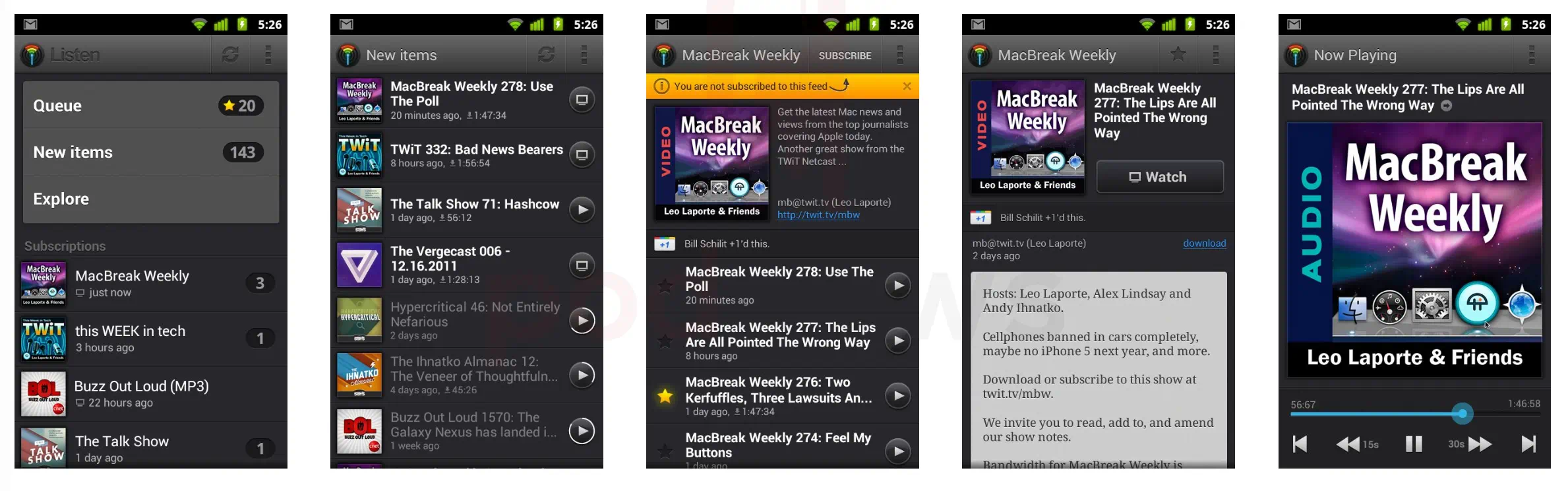
In late 2010 or early 2011, Google Listen v2 was under way. Designs were produced internally, showing a clearer UX, a new logo (Google colours beaming from a transmitter), integration with Google Plus, the company’s social media service, and - yes - support for video.
Here - possibly public for the first time - is what Google Listen v2 would have looked like:
What the company learnt
In a document seen by Podnews, auto-download and queuing were seen as significant benefits: and features we take for granted (only download on wifi, only keep the last three episodes) were hailed as successes.
Google Listen did best with commuters - hence the high session durations, and the fact it was used five days a week. However, Google Listen didn’t cope well with other activities - a family car trip, or an exercise routine.
While it remains an innovative feature, “subscribe to search” wasn’t as successful as the company had hoped. And the company had built some excellent social designs - but hadn’t implemented them, partially because v1 had already built “popular searches” into the app, and so a more in-depth social discovery tool wasn’t seen as being required.
We can even tell you the company’s vision for Google Listen. It was:
Fill the gap in information access when people have partial attention, by providing a “query free” and “query cheap” stream of relevant, personal and engaging audio information.
The inevitable switch to video
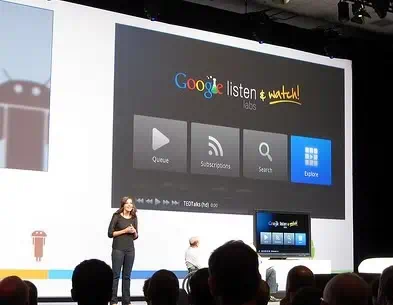
Google Listen may not have made it to v2, but it was the basis for Google TV’s “Queue”, launched in May 2010 for Google TV v1.
If you bought a Google TV-compatible television (Sony made one) or you bought a Logitech box, Google Queue let you subscribe to RSS feeds for audio and video, right on your TV. You’d always have something to watch.
By November 2010, when the Logitech Revue set-top box came out, Google TV apparently had a podcasts app, powered by the same team. The “dedicated podcasts area” wasn’t mentioned by most reviews of the, um, Revue.
The Logitech Revue, described by Harry McCracken as an example of a trend of “products which ship even though they’re clearly not ready to ship”, wasn’t successful, with more boxes returned to Logitech than sold by them.
The Google graveyard
And, as for the Google Listen Android app, v1.1 is as far as the app got.
"The project came out of Google Research, not Android, and so didn’t have a formal home,” someone with knowledge of the product told us. And, in any case, other - better - podcast apps had appeared. Stitcher had originally launched in 2008 and was an Android app by 2010; Pocket Casts launched on Android in March 2011; and AntennaPod launched in July 2012.
So, in August 2012, the company announced that “with Google Play" (the new name for the Android app store), “people now have access to a wider variety of podcast apps, so we’ve discontinued Listen.”
“You deserved better than this”, said GeekWire in a blog post, highlighting that what made it a great podcast app was search - Google’s speciality. "I’ve yet to find another app as good as Google Listen at finding relevant episodes based on searches for specific topics across a large database of shows,” said GeekWire co-founder Todd Bishop.
A Googler involved with the Google Listen project told Podnews: “The vision was for something like Notebook LM - a lean-back audio stream that users could interrupt to change the direction. It wasn’t something we were able to build at the time."
Google returned to podcasts with Google Play Music Podcasts, which launched at the end of 2015 but was only available in the US and Canada, and cached audio. Then, the launch of Google Podcasts in June 2018, which was closed in 2024, replaced (kind of) by YouTube Music and YouTube itself.
But, perhaps the spirit of Google Listen lives on in Google’s “Daily Listen”, which the company calls a personalised podcast based on your Discover feed.
Google Listen was the first in a number of experiments by Google to organise the world’s audio, and make it easy to discover. While Apple Podcasts gets the plaudits, Google Listen still had a part to play in podcasting’s history and growth. We owe its developers a debt.