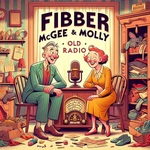


Fibber McGee and Molly - OTR
“Fibber McGee and Molly” OverviewCreators: The show was created and written by Don Quinn and Phil Leslie.Stars: It starred Jim Jordan as Fibber McGee and his real-life wife, Marian Driscoll Jordan, as Molly McGee.Broadcast Period: The show initially aired in 1935 and continued until 1959, making it one of the longest-running and most beloved radio comedies in American history.Characteristics of the Show
- Setting: The show was set in the fictional town of Wistful Vista, where Fibber McGee and his wife, Molly, lived. The comedy derived from the everyday situations and interactions between Fibber, Molly, and a diverse cast of town characters.
- Fibber McGee’s Closet: One of the most famous running gags of the show was Fibber McGee’s closet. Whenever the closet was opened, a huge cascade of items would fall out, symbolizing Fibber’s hoarding and disorganization, much to the amusement of the audience.
- Regular Characters and Catchphrases: The show featured regular characters like Throckmorton P. Gildersleeve, Mayor LaTrivia, and Doc Gamble, each bringing their own quirks to the show. It was also known for its catchy phrases, like Molly’s “T’ain’t funny, McGee!”
- Structure and Humor: Episodes often revolved around Fibber getting involved in various schemes or misunderstandings, with Molly acting as the more sensible counterbalance. The humor was gentle and character-driven, rooted in the interactions and eccentricities of small-town life.
- Impact and Legacy: “Fibber McGee and Molly” was immensely popular for its warm, humorous look at American life. It influenced numerous other radio shows and was a staple of the Golden Age of Radio. The show’s approach to comedy, character development, and the use of running gags set a standard for sitcoms both in radio and later television.
ConclusionWhile George Edwards was not part of “Fibber McGee and Molly,” the show itself remains a significant part of American entertainment history, remembered for its wit, warmth, and the endearing chemistry between its lead actors. It exemplifies the style and humor of a bygone era and continues to be celebrated in the annals of classic radio comedy.
This content was created in partnership and with the help of Artificial Intelligence AI.
© 2026 Inception Point AI · more info
Artwork and data is from the podcast’s open RSS feed; we link directly to audio · Read our DMCA procedure See more
This podcast may use tracking and attribution and dynamic content insertion
Stats: Statistics are produced by Megaphone to help Fibber McGee and Molly - OTR to understand how many downloads it is getting, or how many people are listening. Your device’s IP address and user agent is used to help calculate this figure. Megaphone is IAB v2 certified. Here is more detail about podcast statistics.
Tracking and attribution: Megaphone or its partners may connect the fact you listened to this podcast to an action elsewhere on the internet. For example - it may spot a device that downloaded an episode of Fibber McGee and Molly - OTR later visited the website of an advertiser; or it may track that a device that listened to Fibber McGee and Molly - OTR also listened to a different show. This form of attribution is used to measure advertising effectiveness.
Dynamic content insertion: Megaphone may use limited data that they know about you - the device you’re using, the approximate location you’re in, or other data that can be derived from this, like the current weather forecast for your area - to change parts of the audio. Fibber McGee and Molly - OTR may do this for advertising or for other forms of content, like news stories.
Fibber McGee and Molly - OTR is able to use the above tools since its podcast host or measurement company offers this service. It doesn’t mean that this individual podcast uses them, or has access to this functionality. We use open data.
Listen and follow
 Apple Podcasts
Information for podcasters
- This podcast previously hosted on Spreaker (until Jun 2026), and now hosts with Megaphone. See changes across podcasting.
- This podcast doesn’t have a trailer. Apple Podcasts has a specific episode type for a trailer, which also gets used by many other podcast apps: but there isn’t one correctly marked in the RSS feed from Megaphone.
- There is a different RSS feed listed in the Podcast Index (here) and Apple Podcasts (here). Our systems normally pull RSS feed addresses from Apple Podcasts; and it should normally match what’s in the Podcast Index.
- This podcast appears to be missing from Truefans, Podcast Index, and Luminary. We list all the podcast directories to be in.
- See this podcast’s listener numbers, contact details and more at Rephonic
- Validate this podcast’s RSS feed with Livewire, Truefans or CastFeedValidator