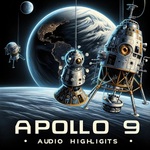


Apollo 9 - Mission Audio
Apollo 9 was a pivotal mission in NASA’s Apollo program, serving as the first full test of all the components of the Apollo spacecraft, including the lunar module, in Earth orbit. The mission was crewed by Commander James McDivitt, Command Module Pilot David Scott, and Lunar Module Pilot Rusty Schweickart. It was launched on March 3, 1969, and lasted for ten days.Key Highlights from Apollo 9 Audio:
- Testing the Lunar Module (LM): One of the primary objectives of Apollo 9 was to test the lunar module, named “Spider,” in the vacuum of space. Audio from these tests includes communications between the lunar module and the command module, named “Gumdrop.” The crew performed maneuvers such as docking and undocking, which were crucial for the success of subsequent lunar missions.
- Spacewalks and Extravehicular Activity (EVA): Rusty Schweickart performed an EVA from the lunar module, testing the Portable Life Support System (PLSS) that would be used on the Moon. The audio includes communications about his activities and conditions, capturing the tension and excitement of the moment.
- Engine Burns and Navigation: The mission included several critical engine burns to simulate maneuvers that would be used during lunar missions. The audio captures the crew’s interaction during these maneuvers, discussing timing, engine performance, and trajectory corrections.
- Earth Observations: The crew of Apollo 9 also made several observations about Earth’s weather and terrain, providing data that would be useful for understanding environmental patterns from space. The audio includes their descriptions and reactions to the views of Earth from orbit.
- Technical Issues and Solutions: Like many space missions, Apollo 9 faced minor technical issues, which the crew managed adeptly. The audio captures their problem-solving in real-time, including troubleshooting unexpected problems with equipment.
The mission’s success demonstrated that the lunar module could perform its intended functions, and the crew could survive independently of the command module if necessary. This mission was crucial for validating the systems and operations that would later enable Apollo 11 to land on the Moon. Audio from Apollo 9 offers an insightful glimpse into the challenges and triumphs of early space exploration, highlighting the crew’s skills in managing both planned and unplanned events during their mission.
This content was created in partnership and with the help of Artificial Intelligence AI.
© 2026 Inception Point AI · more info
Artwork and data is from the podcast’s open RSS feed; we link directly to audio · Read our DMCA procedure
This podcast may use tracking and attribution and dynamic content insertion
Stats: Statistics are produced by Megaphone to help Apollo 9 - Mission Audio to understand how many downloads it is getting, or how many people are listening. Your device’s IP address and user agent is used to help calculate this figure. Megaphone is IAB v2 certified. Here is more detail about podcast statistics.
Tracking and attribution: Megaphone or its partners may connect the fact you listened to this podcast to an action elsewhere on the internet. For example - it may spot a device that downloaded an episode of Apollo 9 - Mission Audio later visited the website of an advertiser; or it may track that a device that listened to Apollo 9 - Mission Audio also listened to a different show. This form of attribution is used to measure advertising effectiveness.
Dynamic content insertion: Megaphone may use limited data that they know about you - the device you’re using, the approximate location you’re in, or other data that can be derived from this, like the current weather forecast for your area - to change parts of the audio. Apollo 9 - Mission Audio may do this for advertising or for other forms of content, like news stories.
Apollo 9 - Mission Audio is able to use the above tools since its podcast host or measurement company offers this service. It doesn’t mean that this individual podcast uses them, or has access to this functionality. We use open data.
Listen and follow
 Apple Podcasts
Information for podcasters
- This podcast previously hosted on Spreaker (until Jun 2026), and now hosts with Megaphone. See changes across podcasting.
- This podcast doesn’t have a trailer. Apple Podcasts has a specific episode type for a trailer, which also gets used by many other podcast apps: but there isn’t one correctly marked in the RSS feed from Megaphone.
- There is a different RSS feed listed in the Podcast Index (here) and Apple Podcasts (here). Our systems normally pull RSS feed addresses from Apple Podcasts; and it should normally match what’s in the Podcast Index.
- This podcast appears to be missing from Truefans, Podcast Index, and Luminary. We list all the podcast directories to be in.
- See this podcast’s listener numbers, contact details and more at Rephonic
- Validate this podcast’s RSS feed with Livewire, Truefans or CastFeedValidator