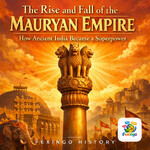

The Rise and Fall of the Mauryan Empire: How Ancient India Became a Superpower — Fexingo History
The Mauryan Empire emerged in the 4th century BCE as the first pan-Indian superpower, unifying the subcontinent under the strategic vision of Chandragupta Maurya and his advisor Chanakya. This series traces its ascent from the conquests of the Nanda Dynasty to the establishment of a centralized administration detailed in the Arthashastra, a treatise on statecraft and economics. We explore the reign of Ashoka the Great, whose transformation after the brutal Kalinga War led to the propagation of Dhamma and the spread of Buddhism across Asia, leaving behind the iconic Ashokan pillars and edicts. The empire’s decline under later rulers like Brihadratha, culminating in the Sunga coup, reveals the fragility of imperial structures in ancient South Asia. Lucas and Luna guide listeners through these pivotal centuries, examining archaeological finds from sites like Pataliputra and Taxila, and debating the empire’s legacy in modern Indian identity and governance. How did a dynasty born in the chaos of post-Alexandrian India forge an enduring model of power and morality? #MauryanEmpire #AshokaTheGreat #ChandraguptaMaurya #AncientIndia #Arthashastra #KalingaWar #Buddhism #Dhamma #Chanakya #Pataliputra #AshokanPillars #IndianSuperpower #RiseAndFall #ImperialHistory #SouthAsia #History #WorldHistory #FexingoHistory Keep every episode free: buymeacoffee.com/fexingo
Copyright details · more info
Artwork and data is from the podcast’s open RSS feed; we link directly to audio · Read our DMCA procedure
This podcast may use tracking and attribution and dynamic content insertion
Stats: Statistics are produced by Spotify to help The Rise and Fall of the Mauryan Empire: How Ancient India Became a Superpower — Fexingo History to understand how many downloads it is getting, or how many people are listening. Your device’s IP address and user agent is used to help calculate this figure. Here is more detail about podcast statistics.
Tracking and attribution: Spotify or its partners may connect the fact you listened to this podcast to an action elsewhere on the internet. For example - it may spot a device that downloaded an episode of The Rise and Fall of the Mauryan Empire: How Ancient India Became a Superpower — Fexingo History later visited the website of an advertiser; or it may track that a device that listened to The Rise and Fall of the Mauryan Empire: How Ancient India Became a Superpower — Fexingo History also listened to a different show. This form of attribution is used to measure advertising effectiveness.
Dynamic content insertion: Spotify may use limited data that they know about you - the device you’re using, the approximate location you’re in, or other data that can be derived from this, like the current weather forecast for your area - to change parts of the audio. The Rise and Fall of the Mauryan Empire: How Ancient India Became a Superpower — Fexingo History may do this for advertising or for other forms of content, like news stories.
This is hosted by Spotify: this may mean that Spotify require you to log in to listen, and from that, they will know considerably more about you, including your email address and potentially a connection with your Facebook account and data.
The Rise and Fall of the Mauryan Empire: How Ancient India Became a Superpower — Fexingo History is able to use the above tools since its podcast host or measurement company offers this service. It doesn’t mean that this individual podcast uses them, or has access to this functionality. We use open data.
Listen and follow
Information for podcasters
- This podcast appears to be only available on Spotify. If that is the case, then the podcaster could get significant extra listens by submitting this show on Apple Podcasts.