
10,000 plays. Zero attention. Disctopia just patented the fix
For years, streaming has built an economy around one deceptively simple number: the play. Someone clicks. A stream starts. A podcast downloads. A view gets counted. But did anyone actually listen? Did they stay? Did they engage? And should a creator whose audience stays for 45 minutes be valued the same as one whose audience disappears after 45 seconds?
Disctopia believes the answer is no — and now it has a U.S. patent behind that position.
Disctopia, Inc. today announced that the U.S. Patent and Trademark Office has issued U.S. Patent No. 12,738,272, covering technology for analyzing content engagement, measuring audience presence, and connecting verified engagement to creator compensation. Founder and CEO Patrick A. Hill is the named inventor. The patent issued with 28 claims and claims priority to June 28, 2023.
“The internet learned how to monetize the click. We built a system around what happens after the click,” said Patrick Hill, Founder and CEO of Disctopia. “A play tells you somebody started something. It does not tell you they cared. It does not tell you they stayed. And it definitely should not automatically tell you what a creator is worth.”
The play count has a problem
Consider two creators. Both generate 10,000 plays. The first holds its audience through nearly the entire program. The second loses most of it within the opening minutes. On a traditional dashboard, both walk into an advertising conversation holding the same headline number.
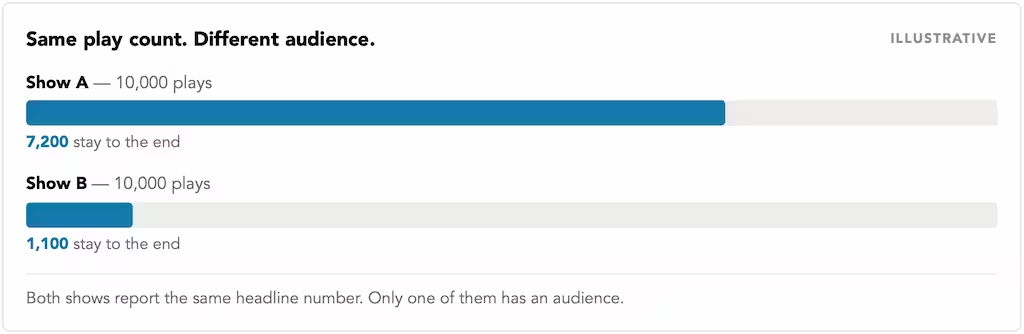
Both shows report the same headline number. Only one of them has an audience. Those audiences are not the same. Their value to an advertiser is not the same. And Disctopia argues their economic value should not automatically be treated as the same.
What it changes for advertisers
Today the same rate buys both shows, because 10,000 is the only number either one can produce. When completion is verified, price can follow attention instead of volume — and the advertiser comes out ahead: paying a premium for the show that holds its audience still lowers the cost per genuinely engaged impression. Inventory inflated by clickbait, or by content looped on a rack of devices, stops competing on equal footing with inventory that has real people behind it. Fraud can inflate a play count. It cannot manufacture an audience that stayed.
What it changes for creator payouts
This is the part the patent actually claims. Every independent claim ends the same way — payment transferred to the content owner as a share determined by the verified presence metric. Engagement is not merely reported back to the creator; it is what sets what the creator is paid. A show with 800 listeners who finish everything can be worth more than one with 30,000 who leave in the opening minutes, and that creator finally has a number to prove it instead of an argument to make.
Put simply: Disctopia is not counting whether somebody pressed play. It is building technology around whether somebody actually showed up.
What the patent covers
- Measuring presence during a stream. Rather than assuming that starting content equals consuming it, the system evaluates activity during streaming and builds a presence metric as consumption continues.
- Measuring engagement. The technology can generate content-aware prompts, evaluate audience responses, and develop an engagement score from those interactions.
- Connecting engagement to compensation. The claims cover transferring resources to content owners with compensation determined in relation to measured engagement.
- Understanding the actual content. Speech recognition converts audio into text and identifies keywords, so the system knows what is being consumed rather than treating every file as an anonymous stream — which further claims extend to supplemental content, purchase attribution, and transfers between advertisers and content owners.
A download is distribution. It is not proof someone listened.
The distinction matters most in podcasting, where an episode can be downloaded to a device automatically without anyone consuming it. Disctopia’s position is straightforward: a download should be reported as a download. It is legitimate distribution data, and Disctopia records it and reports it to creators. But distribution and attention are not the same thing — and neither is moving a playback position forward the same as listening to everything in between.
“Attention should be worth something. Completion should be worth something. Real audiences should be worth something,” Hill said. “And creators should not have to compete against inflated numbers to prove their value.”
Patent details: U.S. Patent No. 12,738,272, “System for Distribution of Content and Analysis of Content Engagement,” issued September 15, 2026 with 28 claims. Application Serial No. 18/758,925, filed June 28, 2024, claiming priority to U.S. Provisional Application No. 63/523,865 filed June 28, 2023; published January 2, 2025 as US 2025/0006191 A1. Inventor: Patrick A. Hill. Assignee: Disctopia, Inc.
About Disctopia
Disctopia is a creator-first streaming and distribution platform for independent creators, media companies, and brands. Podcasts, music, audiobooks, and video live in one ecosystem — with hosting, distribution, monetization, analytics, and audience engagement tools in a single dashboard, so creators can run more of their business from one place. Disctopia has supported video podcasts since 2022. Learn more at www.disctopia.com.
This is a press release which we link to from Podnews, our daily newsletter about podcasting and on-demand. We may make small edits for editorial reasons.