The Price of Visibility: The Hidden Economics of Podcast Video

Podcasting has entered its video era. Or at least, that’s what the industry wants you to believe.
Apple Podcasts is actively pushing video features across its ecosystem, dangling major in-app promotion for shows that bring cameras into the studio. Meanwhile, YouTube has officially overtaken Spotify as the top podcast platform in the UK, mirroring the exact same platform shift the US market went through two years ago. Audiences have a growing appetite for video, and it has become the dominant engine for organic discovery.
But while tech giants march toward a video-first future, a quiet resistance is happening.
According to recent Bloomberg analysis, only 10 out of the top 200 podcasts in the US offer video. Let that sink in for a second: 10 out of 200. That means a staggering 95% of the most successful, revenue-generating shows in the world’s biggest market are actively choosing to stay audio-only.
For an independent creator caught in the crossfire of this platform war, the massive gap between algorithm hype and reality raises a critical question: at what point does video stop being an expense and start becoming an investment?
The answer isn’t found in the narrative. It’s found in the numbers.
Video Is a Customer Acquisition Strategy
For independent creators, video isn’t just a content format. It’s a customer acquisition strategy.
When video becomes your primary customer acquisition channel, the economics matter more than the algorithm.
Every additional hour of filming, editing and production is an investment in acquiring future listeners. Like any customer acquisition strategy, it has to pay for itself. Its value isn’t measured by the number of listeners it acquires, but by how efficiently it acquires them.
As production costs rise, the business doesn’t simply need more downloads. It needs more profitable downloads. Sometimes that requires substantially larger audiences. Sometimes it requires dramatically higher customer value. More often than not, it requires both.
The Video Threshold
Programmatic advertising remains the industry’s default monetisation model, but it generates relatively little revenue per listener. For many independent creators, even meaningful audience growth translates into modest increases in income.
Now compare that with businesses built around direct sponsorships, consulting, memberships, premium products, education or live events. They may attract smaller audiences, but each listener is worth significantly more.
That changes the economics.
A podcast with high customer value doesn’t need millions of viewers to justify investing in video. Each new customer contributes meaningfully towards funding that investment.
A podcast dependent almost entirely on programmatic advertising faces a very different equation. It needs substantially greater scale before the same investment begins to make economic sense.
In other words, every podcast business reaches a point where the economics of video change. Below that point, video behaves primarily as a cost. Above it, video becomes an investment. Let’s call that point the Video Threshold: the point at which a podcast generates enough customer value to fund a sustainable video operation without eroding its margins.
In practice, every podcast’s Video Threshold is determined by three variables: production costs, customer value and monetisation model. Everything that follows simply explains where that threshold sits.
The Cost of Customer Acquisition
If video is a customer acquisition investment, then the cost of acquiring that growth matters. Before we can identify where the Video Threshold sits, we first need to understand what video actually costs an independent business.
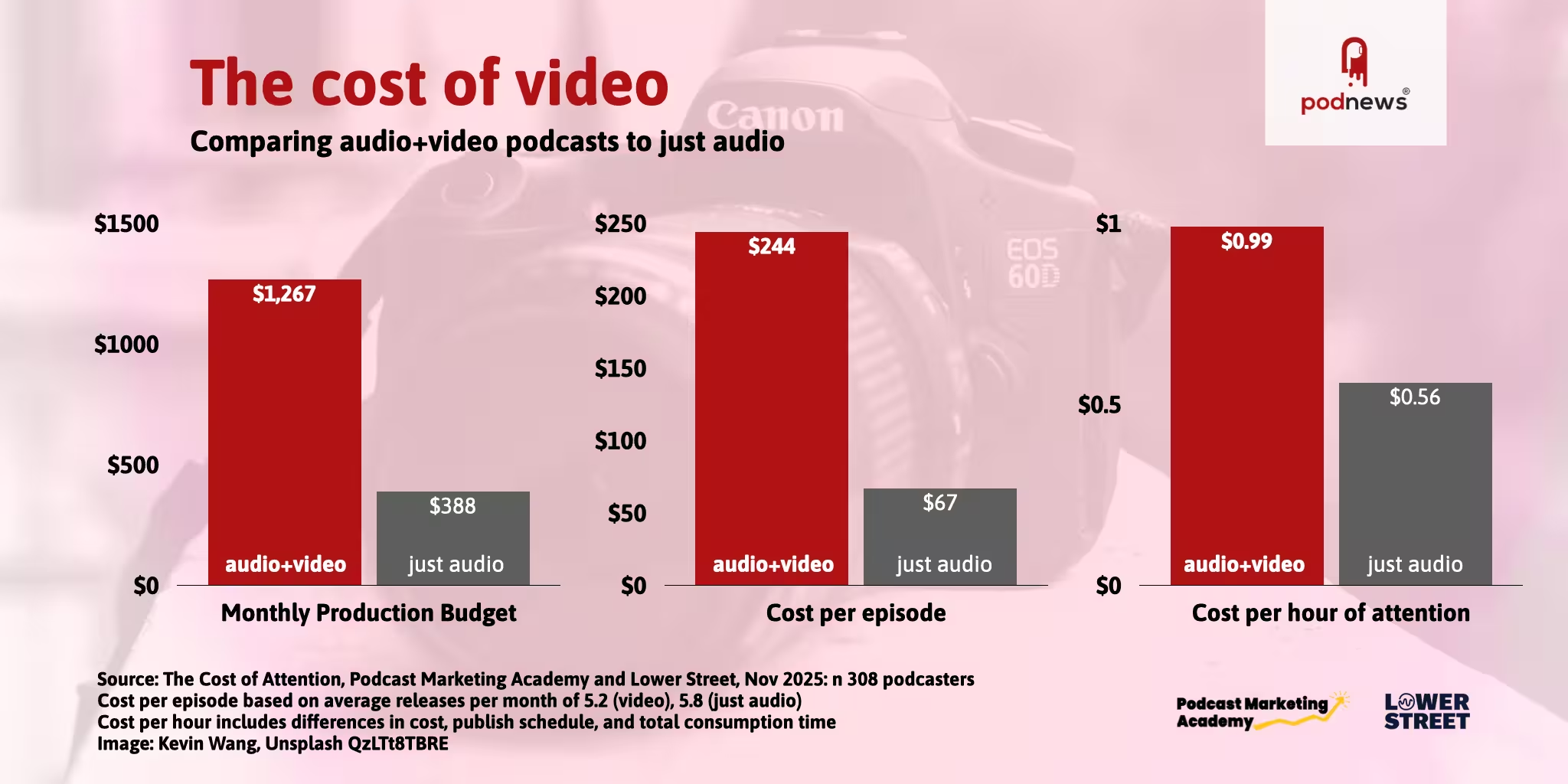
Data from the Podcast Marketing Academy and Lower Street’s Audio vs. Video Podcasting: The Cost of Attention report shows that moving from an audio-only workflow to video increases average monthly production costs from $388 to $1,267. On a per-episode basis, costs rise from $67 to $244—a 3.6x increase.
The cost of holding audience attention rises as well. Producing an hour of audio content costs approximately $0.56 per listener hour. For video, that figure rises to $0.99. Every hour of attention becomes 77% more expensive to produce.
Viewed through the lens of customer acquisition, that additional production spend becomes the cost of winning attention. Whether that investment is economically rational depends on the value the business ultimately generates from the audience it acquires.
Crossing the Video Threshold
The idea of a Video Threshold only matters if it can be measured. To estimate where independent creators cross that threshold, I modelled a podcast relying on programmatic advertising as its only source of revenue. It’s a deliberately simple model, but that’s precisely the point. By stripping away sponsorships, memberships, products and consulting, we can isolate the economics of platform monetisation and identify the point at which video stops being subsidised by the creator and starts being funded by the business.
Take a podcast publishing four episodes a month and averaging 1,000 plays per episode. Under a typical programmatic advertising model, that audience generates approximately $32 per month in advertising revenue. Move that same show to video and monthly production costs rise to $1,267, while blended platform advertising generates only around $24 per month.
The economics deteriorate. Production costs rise dramatically while revenue barely moves.
Scale the model until production costs are fully covered and a clear financial inflection point appears. Under a programmatic-only monetisation model, an audio-first podcast reaches production break-even at approximately 12,000 downloads per episode. A comparable video podcast requires closer to 50,000 video plays per episode before programmatic revenue alone is sufficient to fund the additional production costs.
That is the Video Threshold.
Under a programmatic-only monetisation model, it marks the point at which the business stops subsidising video and video begins funding itself. Below that threshold, every additional camera angle, edit and production hour is effectively financed by the creator in the hope that future audience growth will eventually repay the investment. Above it, the business generates enough revenue for video to become economically sustainable.
Why Customer Value Changes Everything
Programmatic revenue provides a baseline. It reveals where the Video Threshold sits when every additional listener is worth relatively little.
Increase the value of each listener, however, and the threshold moves.
A business built around direct sponsorships, consulting, memberships, premium products or live events doesn’t need exponentially more views because every new customer contributes meaningfully more towards funding the investment. A consultancy generating hundreds of dollars per client, for example, may reach its Video Threshold with only a fraction of the audience required by a podcast funded almost entirely through CPM advertising.
The Podcast Marketing Academy and Lower Street Report reinforces this point. Podcasts producing both audio and video reported customer lifetime values more than 2.6 times higher than audio-only shows. The significance isn’t that video creates higher-value businesses. It’s that businesses capable of generating greater customer value can justify investing in video much earlier. Higher customer value shifts the Video Threshold, reducing the audience scale required for the investment to make economic sense.
This is why audience growth alone is an incomplete measure of success. Two podcasts with identical download numbers can sit on opposite sides of the Video Threshold. One may still be subsidising its video production, while the other can fund it comfortably through the value each customer generates.

The Wrong Growth Equation
The podcast industry has largely adopted a simple growth model: invest in video, grow the audience and the business will follow.
The numbers tell a different story.
Video undoubtedly increases discoverability. But discoverability alone doesn’t create a sustainable business. Every new listener has a cost, and that cost has to be recovered through the value the business generates in return.
For many independent creators, the cost of acquiring new listeners through video increases long before the revenue generated from those listeners does. Growth becomes more expensive, but the underlying economics remain unchanged.
That’s why independent podcast businesses are built in the opposite direction. They first develop a revenue model that increases the value of every listener. That higher customer value moves the Video Threshold. Only then does investing in video become an economically rational way to accelerate growth.
Video doesn’t create a successful podcast business. A successful podcast business creates the conditions that make video a rational investment.
Whose Business Are You Optimising?
The economics of a platform and the economics of an independent creator are not the same.
Apple wants more video. YouTube wants more watch time. Spotify wants richer content. Every additional minute of engagement strengthens their business model.
Yours is different.
Every additional dollar invested in production has to earn its way back. If it doesn’t, growth simply becomes more expensive.
The danger is that platform incentives begin to masquerade as business strategy. Creators are encouraged to optimise for the economics of the platform, rather than the economics of their own business.
That’s the real risk.
Video isn’t inherently good or bad. It’s simply an investment. Like any investment, its value depends entirely on when it’s made. The question isn’t whether video works. The question is when it starts working for your business.
The independent creators who build sustainable businesses won’t be the ones who follow the industry’s loudest narrative. They’ll be the ones who invest when the economics—not the narrative—tell them to.