The tool copying podcasts, stripping the ads, and selling them

A website called PodcastAdBlock is using AI to copy podcasts and resell them without ads, in a service that could have cost the podcast industry almost a million dollars so far.
The company sells access to their own ad-free copies of shows from publishers like Spotify, NPR, the New York Times, Slate, iHeart, and New York Magazine without permission.
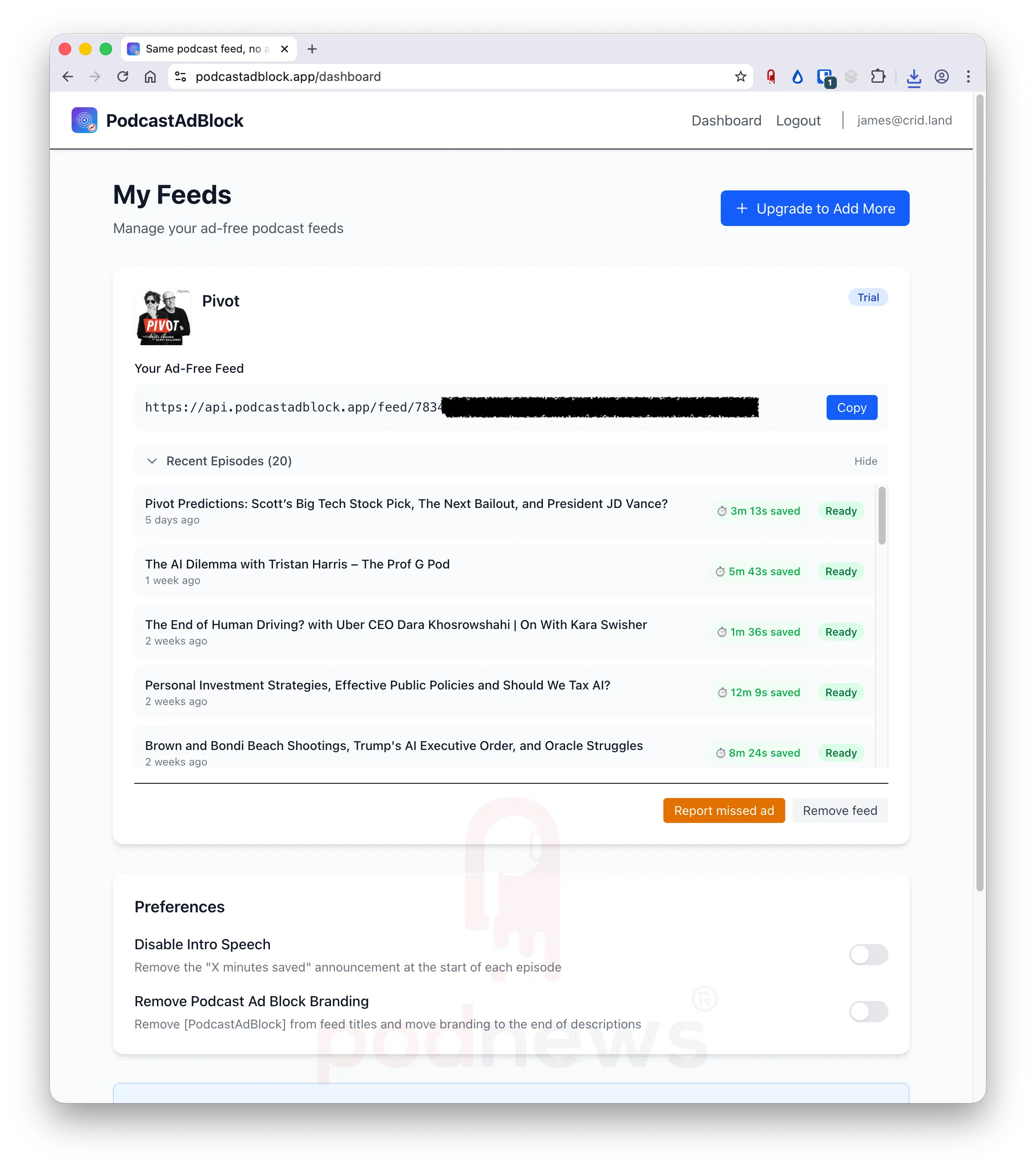
As one example, the tool claims to remove around ten minutes of ads from each episode of Pivot for $1.99 a month. Podnews took advantage of a trial offer to see if it worked. The resulting MP3 file indeed contains no ads, as well as an inserted message saying how many ads were cut out.
The company has been marketing its tool through advertising on Meta’s Facebook and Instagram and on Reddit recently.
Are publishers losing out?
We see no evidence that publishers have knowingly opted-in to this service, or that they get any revenue from it. A company spokesman told Podnews that publishers did not opt-in to be included, and “there is no opt-out mechanism at this time”. The company also clarified that they do not compensate publishers directly.
Some publishers promoted on the website offer their own ad-free versions through Apple Podcasts, SupportingCast or others. This tool could remove that revenue from publishers.
The list of publishers on the website is broad enough to include most large podcast publishers - from WNYC Studios to Audiochuck, Pushkin Industries to Global, Wondery to The Guardian. We’re not convinced that such a large variety of publishers would give their agreement to a tool like this.
The homepage has a number fed by an API that appears to reflect activity within the tool. It claims “78,735 hours of ads removed” for its users so far (the actual number is converted from a total seconds saved figure). Using a conservative $10 CPM for a 30-second spot, that roughly equates to $944,000 of lost revenue for the industry in less than six months.
The company suggests that “this is an illustrative metric” and “does not directly map to listen time from PodcastAdBlock users”.
How legal is this?
It’s Podnews’s opinion that stripping ads and reselling content is illegal under copyright law.
“We do temporarily process and host modified versions of episodes for individual users,” admitted the company. “These are not publicly indexed or redistributed,” they claim - but, of course, these modified versions are redistributed to paying customers.
The tool is based in the UK, where companies must list their registered address and other details on their website. PodcastAdBlock had not done this until we contacted them. It’s now visible that it’s owned by Freewheel Group Ltd, which has one employee, and assets of £323,000 (US $434,000).
Their “24/7 customer support” email address did not respond to our enquiries for three days.
The company says that the service is “similar in spirit to ad-blocking in the web browser space”. We think this is a false equivalence: web browser ad-blockers like uBlock Origin do not make copies of content and republish them to its users; and nor do ad-blockers charge users to remove the ads.
PodcastAdBlock takes payment through Stripe, which prohibits “products and services that infringe on intellectual property rights”. We asked Stripe’s press office whether they considered the company’s activities compliant with Stripe’s TOS. Stripe did not respond to our request for comment.
Ethics and podcasting
Even though the website didn’t say who built it, and their support email wasn’t responding, we discovered the person behind this tool. He’s Ben Bowler. Also a cycling YouTuber, he’s a serial entrepreneur; and in 2025, he launched seven startups.
Bowler has posted a blog about how the service was built, and what tools he used along the way.
In September of this year, he launched another startup - Poison Pill, a tool that is built to protect music from unlicensed AI training. In a story in MusicAlly covering his new tool, Bowler says:
“Musicians’ and rights holders’ content has been scraped relentlessly by generative AI companies, using their music without permission to train and profit from models sold as replacements for working musicians.”
We agree with this.
We’d also suggest that scraping content by podcast publishers, and using their audio without permission on your AI tool to profit from it, is just as unethical.
We put that to him. He didn’t comment.